Tuesday, 13 July 2010

Ultra-High Density Seating

From various media reporting we understand that some airline companies would even want to go for a “Stand-Up Cabin”? We are proposing a 23-inch pitch or less; the “SkyRider”.

Aviointeriors is one of the leading Aircraft Seat and Interiors manufacturers with extensive R&D on the subject. The “SkyRider”, is an ultra-high density seat presently completely engineered and to be finally tested. The SkyRider has been designed and engineered to offer the possibility to even further reduce ticket prices while still maintaining sound profitability, which, even with a dual or three class seating arrangement, will allow maximum certified passenger capacity of the aircraft.

With a much reduced seat pitch, the SkyRider preserves a comfortable position for the low fare passengers.

The SkyRider is intended as a new basic class. The passenger’s seating position is similar to that of a touring motor-scooter rider. This posture permits that the overall longitudinal space occupied by the seat with the seated passenger is far less than that of a conventional, very high-density 28” economy class seat.

Furthermore, in the SkyRider arrangement, a partial overlapping of the passengers seating between rows is allowed, thus further increasing the cabin density.

The seat structure itself also provides space for personal baggage.


Source: Air Transport News

EUROCONTROL advances bring Master Plan deployment closer to reality

EUROCONTROL, together with its partners, has moved forward on a number of activities which are key for Implementation Package 1 (IP1), the foundation for the ATM Master Plan

1. Flight Level Adherence Days: The first ECAC-wide Flight Level Adherence Days will take place on 29 and 30 September 2010. On these two days, airlines will be required to fly at the Requested Flight Level (RFL) as reflected in the filed flight plan.

Flight plan information is used by CFMU and FMP’s to optimize network operations, such as resolving anticipated traffic overloads in specific sectors through proposed re-routings and/or ATFCM departure slots (CTOT).

Deviations from the flight plans can lead to inaccurate ATFCM measures, sector overloads, waste of capacity and less overall network capacity and flight efficiency. Over the past few years, the need to address this has been raised repeatedly by European ATM players. In early 2009, EUROCONTROL, on request from ANSPs, launched the “Flight Plan & ATFCM Adherence Campaign”, as a short-term performance improvement initiative in the context of DMEAN and the Flight Efficiency Plan. On the basis of two local flight level adherence trials by Maastricht and Karlsruhe centres, the Adherence Task Force (with ACI, IFATCA, ECA, IATA, IACA, EUFALDA and ANSPs) proposed the “Flight Level Adherence Days”. Preparation is now in full swing, including guidance and awareness material and wide publicity through social media such as Facebook and Twitter (see www.adherencedays.com and www.eurocontrol.int/adherence). This trial will provide essential input on the next steps toward improving network performance and reducing sector overloads.

2. Improved ab-initio selection procedures through the FEAST test: FEAST (the First European Air traffic controller Selection Test) service has reached a landmark since its inception in 2004. 20,000 young applicants for the job of ATC trainee from all corners of Europe have taken the FEAST selection tests.

In the very specialized selection process for ATC, only a few applicants have the combination of abilities and skills which suggest they have a good chance of being successful at the long and difficult ATCO training. The EUROCONTROL FEAST service currently provides 32 civil and military ANSPs in the ECAC area with the FEAST selection system for their own use in the recruitment and selection of ab-initio air traffic controllers. The online psychometric test battery which was designed specifically for ATC selection, measures cognitive abilities and skills of applicants. It allows selection decision makers to make better-informed and more objective judgments about the suitability of applicants.

As part of the service, EUROCONTROL offers full implementation support including the technical infrastructure for the delivery of the tests and professional support including Europe-wide validation of the test battery.

Performance measures of the FEAST service conclude that the tests have predictive validity and represent a cost effective solution for ANSPs.

3. AIM: Significant changes to the Standard and Recommended Practices (SARPs) on electronic Terrain and Obstacle Data (TOD) are underway thanks to the recent Amendment 36 and its corrigendum to ICAO Annex 15. the European TOD stakeholder group, co-ordinated by EUROCONTROL, has produced an initial Terrain and Obstacle Data guide to clarify the SARPs further and to address some of the outstanding discrepancies. ICAO intends to publish this as the official ICAO Guidance Manual so everyone can benefit from the European implementation experience.

4. Conclusion of the Digital SNOWTAM Trial: A pre-operational Trial was executed by EUROCONTROL between November 2009 - April 2010 in which the information contained in SNOWTAM messages (airport surface contamination with snow/ice, friction coefficient, etc.) was converted into digital AIXM 5.1 data. The data was used to create graphical views which were made available to Airline Operational Centres. Some major Airlines jointed the trial expressing full support for the concept and their desire for such data services to become fully operational and to also be integrated into the CFMU NOP Portal.

5. LINK 2000+: In support of the Data Link Services Implementing Rule, the TEN-T Executive Agency decided in Dec 2009 to fund the Datalink Incentives Scheme for Airborne equipage. EUROCONTROL is administering the fund and will ensure that all aircraft funded under the scheme are equipped in 2011 and 2012. A first call for tender to Airspace Users was issued in January 2010, as a result contracts are now being placed with 19 companies. A new and final call for tender was launched on June 25th to allow additional Airspace Users to join the scheme. EUROCONTROL expects to make associated contracts in September 2010.

Source: Air Transport News

Monday, 14 June 2010

Africa Aviation Outlook: Cooperation, liberalisation and protectionism

As African governments sought a path to successful locally-based airline operations, some attempted to gain the benefits of scale and coverage by forming joint airlines. With a good deal of support from European governments and flag carriers, two early examples of airlines jointly representing the interests of neighbouring countries shared resources, costs and – hopefully - the profits.
These examples of regional cooperation were:
1) Air Afrique, based in francophone West Africa (covering Benin, Cameroon, Central African Republic, Chad, Congo-Brazzaville, Gabon, Ivory Coast, Mali, Mauritania, Niger, Upper Volta (today’s Burkina Faso) and Senegal.); and
2) East African Airways, in ex-British administered countries (Kenya, Uganda and Tanzania) in the east of the continent.
From its founding in 1961, Air Afrique, originally with financial and operational support from France, struggled on until it eventually folded in 2001, reduced to a fleet of only three aircraft and with massive debts.
East African Airways had even earlier beginnings, but was dissolved in 1977, following which each of the three partner countries then set up their own flag carriers.
Another, more commercially-originated grouping was established by South African Airways in 1994, with a joint venture airline, Alliance, an international partnership between SAA, Air Tanzania and Uganda Airlines. However, Kenya Airways proved too competitive for the grouping and it ceased operations. Then there are the cross-border equity/operating investments, such as the now defunct Virgin Nigeria, as well as the more successful KLM-Kenya Airways JV.
In north Africa, a more limited form of alliance, known as the Arabesk Network Coordination Project was formulated in 2005 under the aegis of the Arab Air Carriers Organisation. Arabesk, along with several Arab carriers, includes EgyptAir and Tunisair and was designed to increase the mutual power of its members, coordinating schedules and consolidating joint fuel purchasing.
Individual airlines in countries with domestic markets, stronger economies and longer experience have however been more successful, with South African Airways, EgyptAir, Air Algerie, Royal Air Maroc and Ethiopian Airlines being conspicuous examples of long-term operational survival – often with some help from European airlines and, frequently their own governments. Kenya Airways too has staked a strong reputation since its post-EAA inauguration and there are newer examples which may also prosper, as liberalisation seeps through and private airlines are established.

Many African nations have concluded Open Skies agreements with the US – but not with each other

Zambia was the most recent African nation to conclude a liberal “open skiesbilateral air services agreement with the US, but over the past decade, the list has become impressive, as the US gathers supporters to its liberalisation crusade.
African nations with Open Skies agreements with the US
Tanzania
Provisional
11.3.99
Namibia
C&R
2.4.00
Burkina Faso
In force
2.9.00
Ghana
In force
3.16.00
Gambia
In force
5.2.00
Nigeria
Provisional
8.26.00
Morocco
In force
5.2.00
Rwanda
N/A
10.11.00
Benin
N/A
11.28.00
Senegal
C&R
12.15.00
Uganda
In force
10.27.09
Cape Verde
In force
6.21.09
Madagascar
Provisional
3.10.04
Gabon
In force
5.26.04
Maldives
In force
5.5.05
Ethiopia
Provisional
5.17.05
Mali
In force
10.17.05
Cameroon
In force
2.16.00
Chad
Provisional
5.31.06
Liberia
In force
2.15.07
Kenya
C&R
5.30.08
Zambia
In force
16.3.10
However, many of these agreements are still not fully effective, if at all. Nor, in most cases will there ever be direct services to the US from these countries.
However, depending on their precise terms, the agreements facilitate indirect services, a feature that becomes increasingly important (and sometimes surprising to the non-US party) as alliances and codeshare partners are able to exploit the terms more effectively.[1]
The flexibility and usefulness of these agreements in turn often necessitates liberal access terms in the understandings with third countries within the region, if through services are to incorporate fifth freedom operations. These rarely exist, despite the obvious advantages of liberalisation among often excessively jealous neighbours.
The bottom line is that, despite the unwillingness of African nations among themselves to liberalise, these open skies agreements may offer some impetus to reforming local regulation. As the clamour for new sources of energy continues unabated, the prospect increases that foreign airlines will leverage every opportunity to use the agreements to establish new access, either directly or through a combination of bilateral agreements and alliance relationships.
As a minimum, they stand as symbols of what might have been. They also represent a very strong hint to African states that multilateral – or at least bilateral – liberalisation among themselves is the only serious way to proceed.
This is an extract from an article, available for CAPA Members, or by individual purchase, which includes the following sections and analysis:
  • 2. The dilemma: protectionism or liberalisation – or both?
  • 3. Better to look for international partnerships and liberalise intra-regionally
  • Conclusion: In the end the market will have its way; but infrastructure will be found wanting
Source: CAPA

Thursday, 10 June 2010

Greater flexibility required to adjust to unfavourable economic conditions

The EUROCONTROL Performance Review Commission (PRC) has issued its Performance Review Report for the year 2009, which was marked by an unprecedented traffic downturn. It presents an assessment of the performance of European Air Navigation Services (ANS) under the Key Performance Areas of Safety, Punctuality & Predictability, Capacity & Delays, Flight Efficiency, Environmental impact, and Cost-Effectiveness.

The report highlights that:

„X While there is a continuous increase in the reporting of incidents in many States, the number of reporting States remains relatively low and has not increased in the last five years.

„X Not all the States have taken the necessary measures to achieve a fully non-punitive reporting system and ¡§just culture¡¨ should be implemented where this is not already the case.

„X States and ANSPs should use automatic detection and reporting tools so as to further improve the transparency of ANS safety.

„X Increases in en-route delays over the period 2003-2008 nearly cancelled out the benefits of improvements in cost-effectiveness, hence the need for a balanced approach to performance.

„X Issues leading to high delays in the top 30 delay generating sectors have to be resolved urgently.

„X Given the severe economic downturn, there is a need to effectively implement the planned cost containment measures so that they materialise into genuine cost-savings for airspace users and contribute to improving the total economic cost of ANS.

„X The design and use of airspace for both civil and military needs has to be further improved and a more effective use of airspace released to civil operations has to be made.

„X Airport stakeholders should constructively engage in the PRC-led process of development of indicators and targets addressing operational performance at and around airports and in the building of a comprehensive and reliable database that can adequately support it.

The economic downturn has affected the aviation community throughout 2009 with unprecedented severity, requiring greater flexibility on air navigation service providers and EUROCONTROL to adjust to new unfavourable economic conditions. In this context, the pressure to genuinely improve costeffectiveness is high on the agenda of airspace users¡¦ expectations¡¨, says John Arscott, Chairman of the PRC.

The full report is available here: www.eurocontrol.int/prc 

Source:  Air Transport News

Emirates declares war on the world’s flag carriers with order for 32 more A380s


If anyone was wondering where Emirates was planning to place its 58 A380s, it was obviously not CEO, Tim Clark. Yesterday at the Berlin Airshow the astonishing airline made another firm orders for 32 of the mega-jumbo. This takes to 90 the number of A380s to Emirates' account. The vast size of the order, the largest in aviation history, is dramatic in its direct challenge to the old airline industry. But it also carries with it equally massive indirect implications.
The order for the additional aircraft has a list price of $US 11.5 billion (AED 42.2).  The agreement was signed today during a ceremony at the Berlin Air Show by His Highness (H.H.) Sheikh Ahmed Bin Saeed Al-Maktoum, Chairman and Chief Executive, Emirates Airline and Group and Tom Enders, Airbus President and CEO which was witnessed by German Chancellor Angela Merkel and other dignitaries.
Seated at the table making today’s announcement: His Highness (H.H.) Sheikh Ahmed Bin Saeed Al-Maktoum, Chairman and Chief Executive, Emirates Airline and Group (left) with Tom Enders, President and CEO, Airbus (right). Looking on in the back row, left to right: John Leahy, Chief Operating Officer –Customers, Airbus; Tim Clark, President, Emirates Airline; Angela Merkel, German Chancellor; Rainer Brüderle, Federal Minister of Economics and Technology; Dr. Peter Ramsauer, Minister of Transport; Louis Gallois, Chief Executive Officer, Airbus.
“This latest order, adding to 58 A380s previously ordered, affirms Emirates’ strategy to become a world leading carrier and to further establish Dubai as a central gateway to worldwide air travel.  The A380 is our flagship in terms of passenger comfort, innovation, operating and environmental efficiency and revenue generation,” said H.H. Sheikh Ahmed Bin Saeed Al- Maktoum. “Our latest commitment signals Emirates’ confidence in the growth to come in a thriving aviation sector as we build our fleet for tomorrow,” he added.
“Emirates supported the development of the A380 from the earliest days, a project employing tens of thousands of Europe’s best people and today’s increased order, is the best endorsement I can imagine. On behalf of all of us at Airbus, we thank Emirates for their support. The A380 is indeed a remarkable eco-efficient aircraft, a profit generator for airlines and a great flying experience for passengers,” said Tom Enders.
Emirates, the second largest airline in the world in available seat kilometres, is on track to become one of the largest airlines in the world.  In addition to the orders placed today, Emirates has 48 Airbus 380s, 70 Airbus 350s,  18 Boeing 777-300s and 7 Boeing air freighters on order totaling 143 wide-body aircraft worth more than $US 48 billion. In a year where the aviation industry was rocked by the economic downturn, Emirates Airline recently reported its 22nd  year of profit, up 416 percent to close at US$ 964 million (AED 3.5 billion) over its 2008-09 profits of US$ 187 million (AED 686 million). From the delivery of its first A380 in July 2008, to receiving it 10th A380 on 7th June 2010 from the Airbus plant in Hamburg, Emirates is now serving eight international destinations with the super-jumbo aircraft including London Heathrow, Toronto, Paris, Jeddah, Bangkok, Seoul, Sydney and Auckland. The airline will start A380 services to Beijing from 1st August, Manchester from 1st September and will return service to New York’s John F. Kennedy (JFK) airport on 1st October.  Emirates’ looks forward to expanding the list of destinations at more than 100 airports around the world as A380s become ready.


Sources: CAPA, Emirates.com


Outlook for global airline alliances in Africa

As global alliances gather momentum, radiating from their core partners in Europe and North America, each region is experiencing the influence that the groupings can bring. Africa is no exception, but the lack of fully viable locally based carriers offers something of a challenge in finding partners to expand beyond the small number already accounted for.
Nonetheless, the role of global alliances seems sure to increase competition on the African continent. But whether this will improve on the current north-south route bias is doubtful; in fact, the opposite is possibly the likely outcome.
When EgyptAir joined Star Alliance in 2008, Jan Albrecht, CEO of the Alliance, was bullish about Africa’s aviation future: “half of our members (are) flying to the African continent…The economic and business climate of Africa is getting the world’s attention.” He also believed the “Star Alliance is well positioned to serve the business interests of the continent by having EgyptAir in the north, South African Airways in the south, and nine other member airlines flying to Africa.”
It does look that way, as Star appears best established – numerically, at least, of any of the alliances. Both of continental Europe’s major airlines, Air France-KLM and Lufthansa, have extensive links to and from Europe in their own right. British Airways, a lead member of the third global alliance, also has its own network, albeit smaller than the other two.
Unaligned Emirates Airline is expanding its presence too, providing links from Europe and Asia. The UAE carrier has created a sufficient threat to Europe-Africa operations that Lufthansa last year felt the need to take legal action to prevent Emirates from price leading on Germany-South Africa routes.
As the underdeveloped African market grows, the competition among offshore airlines will only intensify, with increasing benefits for African consumers and for intercontinental trade flows.
Meanwhile, although Asian and European connections are well developed, American carrier direct links remain rare, with only SkyTeam’s Delta actually currently operating; the carrier flies between Atlanta and Accra, Lagos, Johannesburg and Cairo and from New York JFK to Accra, Cairo, Dakar and Lagos, with a codeshare on Royal Air Maroc’s metal to Casablanca. United is to commence its own Chicago-Accra service in Jun-2010 (and possibly extended to Lagos), currently codesharing on EgyptAir services between Cairo and JFK and on SAA’s between Chicago and JFK-Johannesburg. Meanwhile the bulk of the access, particularly to northern Africa, is over European gateways.
In the absence of a wide range of locally available partners, the core European airline services will persist strongly, with a large portion of long haul passengers connecting over Europe to access African points. But, as noted, Star Alliance has taken the initiative in capturing some of Africa’s more eligible partners, EgyptAir, Ethiopian Airlines and South African Airways, while the Dutch part of the SkyTeam leaders has an established relationship with east Africa’s Kenya Airways; this offers a useful complement to Air France’s longstanding links with the north African francophone airlines.
In terms of coverage, Sky Team, of the global groupings, would appear to have the most comprehensive airline partnerships in the continent. The following summarises many of those relationships for each alliance.

(1) SkyTeam: a powerful set of connections from Europe

Air France/KLM is thus particularly strong in Africa in its own right, thanks to a combination of the longstanding French colonial links and the substantial access that KLM has established to mostly English speaking nations. Delta has been on-again/off-again in its entry to Nairobi, although there are hopes of a connection, probably via the west coast of Africa, later in 2010.
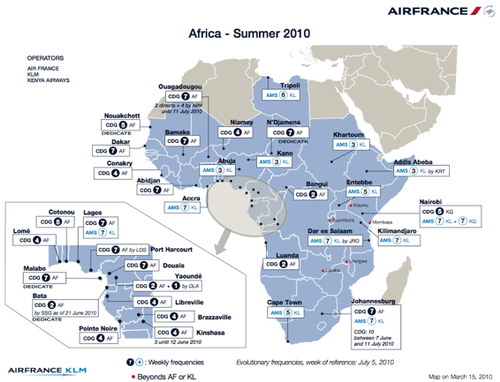
The Air France-KLM coverage however enables the SkyTeam combination to dominate European access to the continent, from north to south and from east to west, with a total of 42 destinations across 33 African countries. Access has also been augmented by regional alliances established, for example, through KLM’s alliance an equity holding in Kenya Airways.
Air France-KLM’s African route network
Combined with the Kenya Airways network, the strength of the alliance in southern Africa is also greatly enhanced.
Kenya Airways’ African route network
Also, as noted below, Air Algerie is in the process of becoming a SkyTeam member, although it has not yet complied with the necessary criteria.
Royal Air Maroc has one foot in the alliance also, with close commercial links to both Air France and US SkyTeam’s Delta, and Tunisair also has had a long term relationship with Air France.
This is an extract from an article, available for CAPA Members, or by individual purchase, that includes the following sections/data:
  • (2) Star Alliance: greater partner presence on the continent


    • Lufthansa’s African route network
    • South African Airways’ African route network
    • EgyptAir’s African route network
    • Turkish Airlines’ African route network A galaxy of Stars
  • (3) oneworld: the most modest alliance player in Africa


    • British Airways’ African network, with Comair route network in southern Africa
    • Iberia’s African network
  • Potential alliance members: limited options remain


    • Key data for selected African airlines: Home country capacity, Fleet (current and orders) and Capacity share of African continental market
  • Royal Air Maroc prospects
  • Arik Air prospects
  • Tunisair prospects
  • Remaining options? Only Nigeria an obvious target
  • Conclusion: An uncertain impact from the alliances 
 Source: CAPA

Wednesday, 2 June 2010

RYANAIR’S FULL YEAR PROFIT RISES 204% TO €319M FARES FALL 13%


Ryanair today (June 1) announced full year Profits of €319m after tax, an increase of 204% over last years €105m profit. The airline also proposes to pay a one-off dividend of €500m (€0.34 per share) in October, subject to shareholder approval at its September AGM.

Annoucing those results, O'Reilly said:
“The principal highlights of the past year include:-
• Profits trebled to €319m.
• Traffic growth of 14% to 67m.
• 51 net new aircraft (y/e fleet 232xB737-800’s).
• 8 new bases Bari, Brindisi, Faro, Leeds, Oslo Rygge, Pescara, Porto, Trapani (total 42).   
• 284 new routes (total 940).
• Passenger service statistics further improved (No 1 on time major airline).
• A dividend of €500m proposed (€846m returned to shareholders over the past 3 years).
Results
We can be proud of delivering a 200% increase in profits and traffic growth during a global recession  when many of our competitors have announced losses or cutbacks, while more have gone bankrupt including, Bluewings (Ger), Globespan (UK), My Air (Italy), Segal Air and Sky Europe (Slovakia). Revenues rose 2% to €2,988m as air fares fell 13% while traffic grew 14% to 67m. Unit costs fell 19% due to lower fuel and rigorous cost control. Ancillary sales grew 11% to €664m slightly slower than traffic growth, and amounted to 22% of total revenues.   
Fuel costs declined 29% to €894m as oil prices fell from $104 to $62 pbl. We extended our hedging program to 90% for FY11 (at $730 per tonne), 50% of Q1 FY12 (at $750 per tonne) and 20% of Q2 FY12 (at $750 per tonne). Excluding fuel other unit costs fell by 3%.   
Capacity cuts by many European flag and non flag carriers caused traffic to fall at many major European airports. We are inundated with offers from large and small airports competing with lower costs and efficient facilities to win Ryanair’s growth. Our airport and handling unit costs fell by 9% despite steep increases at Dublin and Stansted. New routes and bases launched this year will ensure that despite a scandalous (up to) 40% increase in charges at Dublin airport, our airport and handling unit costs will decline again in FY11.    
The balance sheet has strengthened as cash has risen by €535m to €2.8bln. We took advantage of recent historically low rates to lock in many of our 2009/2010 deliveries at an all inclusive long term interest cost of under 4% pa. We are fully financed for the remaining 34 deliveries out to January 2011. 
Our long term dollar hedging strategy for capex, which extends to the end of 2011, means that we will be purchasing aircraft in 2010/2011 at exceptionally low euro prices with a €/$ exchange rate of 1.46, significantly better than current rates.
Current Issues.
As we predicted Ireland’s tourism industry collapsed in 2009. Traffic at Dublin fell by over 3m (-13%) in a year when Ryanair’s traffic grew by 8m. Traffic at Dublin in 2010 to date has fallen by a further 14%. Ireland’s damaging €10 tourist tax and the govt. imposed (up to) 40% cost increases at Dublin airport will lead to a second year of government inspired tourism collapses. The opening of the DAA’s €1.2bln T2 in November is unnecessary as capacity at T1 has reached 30m pa while Dublin’s traffic will fall to under 18m in 2010. The DAA should mothball T2 which will reduce their operating costs, slash their high fees, and the government must scrap this damaging €10 tourist tax if Ireland is to return to being a competitive destination and reverse this 2 year tourism collapse.   
The Icelandic volcanic ash “monitoring” led to repeated, unnecessary, closures of large swathes of European airspace over 18 days from the 15th of April. These closures have caused the cancellation of 9,400 Ryanair flights, and the loss of 1.5m passengers up to the 18th of May. The full cost of these cancellations will not be known for some time and will depend on the claims we receive under the unfair and disproportionate EU261 regulations. We estimate the cumulative exceptional cost of these unnecessary cancellations is approx. €50m and we will continue to up-date shareholders quarterly on the likely final outcome.  The recent revisions of the VAAC charts for guesstimating the position of non-existent volcanic ash “clouds” highlights the mismanagement of these eruptions by EU governments and regulatory agencies, who repeatedly and unnecessarily closed European air space.     
EU 261 is a manifestly unfair, disproportionate and discriminatory regulation which requires airlines to reimburse expenses of disrupted passengers even in force majeure cases. While volcanic ash airspace closures disrupted 1.5m Ryanair passengers over a period of 18 days we believe that airlines should not be exposed to such unlimited liability when the cause of these cancellations were clearly beyond the airlines control. Other competing transport providers such as coaches and ferries are not obliged under EU 261 to meet the cost of care during force majeure events. EU 261 needs to be amended to include a force majeure clause to relieve EU airlines of the “duty to care” obligations in such cases.     
The EU 261 legislation is also disproportionate as there is no cap on either the quantum or the period that air passengers can claim for.  This discriminates against airlines because coaches and ferries have their liability limited to the ticket price paid which caps their exposure. The airlines’ liability to compensation and right to care reimbursements should also be limited to the ticket price paid.   This would restore proportionality to the regulation since air passengers who have chosen to pay lower fares, and have benefited from significant savings, cannot and should not expect to receive unlimited compensation or reimbursements.    
Proposed €500m Dividend.
In December 2009 we ended our discussions for a 200 new Boeing aircraft order. Since we don’t anticipate a new deal with Boeing for the foreseeable future, our gross capex will fall substantially over the next 3 years. We expect to generate up to €1bn in surplus cash by the end of FY13. We now propose to return €500m of this cash in a one off dividend in October 2010 subject to shareholder approval at our September AGM. We also anticipate that there may be a further €500m (absent any new aircraft orders or other capex) available for return to shareholders either via share buy backs or another one off dividend by the end of FY13. This €500m dividend if approved in September will bring to €846m the amount of funds returned to shareholders by Ryanair in share buy backs and dividends over the past 3 years.   
Outlook.
We expect to grow traffic in FY11 by 11% to 73.5m (subject to volcanic ash disruptions). Fuel costs will increase by €300m. However, subject to no further air space closures and an early return to normal bookings, we expect airfares (which fell 13% last year) to rise by between 5% to 10% due to the positive impact of our new routes and bases. Some of these, such as Faro and Malaga, are already producing higher fares during the summer although they will lead to a 10% increase in sector length. Q1 will be adversely impacted by weaker yields in May and June due to the volcanic ash disruptions, and the inclusion of part of Easter revenues in the prior period, as a result Q1 Net Profits are expected to be slightly lower than last year.    Overall we expect costs per passenger to rise by 4% in 2010/11 (sector length adjusted they will fall by 6%). If as we expect, higher yields offset increased fuel and other operating costs, then profits (excluding exceptional costs from the recent volcanic ash disruptions) for the coming year should rise by between 10% to 15% to a range of approx. €350m to €375m”.

Source: Air Transport News

Friday, 28 May 2010

NextGen Goal: Performance-Based Navigation

RNAV and RNP Evolution Through 2025

The Next Generation Air Transportation System (NextGen) is the Federal Aviation Administration’s plan to modernize the National Airspace System (NAS) through 2025. Through NextGen, FAA is addressing the impact of air traffic growth by increasing NAS capacity and efficiency while simultaneously improving safety, reducing environmental impacts, and increasing user access to the NAS. To achieve its NextGen goals, FAA is implementing new Performance-Based Navigation (PBN) routes and procedures that leverage emerging technologies and aircraft navigation capabilities.
legend
map

What is Performance-Based Navigation?

Performance-Based Navigation (PBN) is comprised of Area Navigation (RNAV) and Required Navigation Performance (RNP) and describes an aircraft’s capability to navigate using performance standards.

What Is RNAV?

RNAV enables aircraft to fly on any desired flight path within the coverage of ground- or spaced-based navigation aids, or within the limits of the capability of aircraft self-contained systems, or a combination of both capabilities.

What Is RNP?

RNP is RNAV with the addition of an onboard performance monitoring and alerting capability. A defining characteristic of RNP operations is the ability of the aircraft navigation system to monitor the navigation performance it achieves and inform the crew if the requirement is not met during an operation. This onboard monitoring and alerting capability enhances the pilot’s situation awareness and can enable reduced obstacle clearance. 
Certain RNP operations require advanced features of the onboard navigation function and approved training and crew procedures. These operations must receive approvals that are characterized as Authorization Required (AR), similar to approvals required for operations to conduct Instrument Landing System Category II and III approaches.

Global Support

In March 2007, the International Civil Aviation Organization (ICAO) completed the PBN Manual which involved collaboration with technical and operational experts from several countries. The ICAO PBN Manual provides global harmonization of RNAV and RNP requirements – a leading priority of the aviation stakeholder community worldwide. To promote global awareness and understanding of the new Manual, FAA and the European Organization for the Safety of Air Navigation (EUROCONTROL), with the ICAO PBN Program Office, have presented seminars throughout the ICAO Regions. All of the10 planned seminars were completed as of December 2008.

Benefits

RNAV and RNP specifications facilitate more efficient design of airspace and procedures which collectively result in improved safety, access, capacity, predictability, operational efficiency, and environment. Specifically, improved access and flexibility help to enhance reliability and reduce delays by defining more precise terminal area procedures. They also can reduce emissions and fuel consumption.
RNAV procedures can provide benefit in all phases of flight, including departure, en route, arrival, approach, and transitioning airspace. For example, Standard Terminal Arrivals (STARs) can:
  • Increase predictability of operations
  • Reduce controller/aircraft communications
  • Reduce fuel burn with more continuous vertical descents
  • Reduce miles flown in Terminal Radar Approach Control (TRACON) airspace
  • Reduce interaction between dependent flows in multiplex airspace

NextGen in Motion:  Optimized Profile Descent (OPD)

As a component of its Trajectory-Based Operations NextGen initiative, FAA has authorized development of arrival procedures with vertical profiles optimized to facilitate a continuous descent from the top of descent to touchdown. OPD is designed to reduce fuel consumption, emissions, and noise during descent by allowing pilots to set aircraft engines near idle throttle while they descend. OPDs use the capabilities of the aircraft Flight Management System to fly a continuous, descending path without level segments. Where possible, we are implementing OPDs with RNAV to make them environmentally-friendly or "green."

OPD in Action

The FAA successfully conducted OPD procedure tests at Anchorage, AK (ANC) in June 2009. This OPD procedure will reduce radio clutter, offer predictable profiles, and increase safety. Flight simulation modeling estimates an average of 1,000-1,300 pounds of fuel saved per flight, thereby leading to a reduced carbon-footprint. Similarly, a second OPD/RNAV STAR procedure was a tested in August 2009. This Southeast arrival will afford OPD savings and reduced congestion for those aircraft arriving from the lower-48 states.
Operationally, for an OPD, the participating aircraft is issued a "Descend via" clearance from the Air Route Traffic Control Center allowing the aircraft pilot to select the top of descent point that provides the best operating efficiency for the arrival. Following the transfer of control to the Terminal Radar Approach Control facility, aircraft receive a clearance for the instrument landing approach. Subsequently, the aircraft is instructed to contact the tower outside the final approach fix. During this procedure, the aircraft throttles are at "flight idle" from the top of descent until just prior to configuring for landing on final. The reduction in radio communication as a result of OPD affords the controllers extra time to scan the operational environment and work other traffic.
RNAV STAR OPDs have been implemented at Phoenix, AZ; Los Angeles, CA; San Diego, CA; Atlanta, GA; and Las Vegas, NV with development underway in Anchorage, AK; Honolulu, HI; Charleston, SC; and Reno, NV.

Phoenix(PHX) RNAV Arrivals

Since the implementation of two RNAV STARs at PHX in October 2006, significant benefits have been noted:  38 percent reduction in the time aircraft remain in level flight; user benefit savings estimated at $4 million through 2008; and reductions in carbon dioxide emissions estimated at 2,500 metric tons annually.
Similarly, RNAV Standard Instrument Departures (SIDs) can:
  • Reduce departure delay via diverging departure routes off the runway
  • Reduce interaction between dependent flows
  • Reduce controller/aircraft communications
  • Reduce miles flown in TRACON airspace
  • Increase predictability of operations

Atlanta (ATL) RNAV Departures

Atlanta implemented RNAV SIDs in 2006 and 2007, allowing an additional diverging departure course with measured benefits of:
  • 24-43% reduction in departure delays
  • $105 million in operator benefits through 2008
  • 6 additional departures per hour when no wake separation is required

Dallas-Fort Worth (DFW) RNAV Departures

Utilizing RNAV, DFW implemented initially diverging, fanned routes in September 2005. These new RNAV SIDs resulted in benefits of:
  • 45% reduction in delay during peak demand
  • $25 million in operator benefits through 2008
  • 10 additional departures per hour per runway
departures
Utilizing curved leg segments supported by RNP could increase savings at DFW by approximately $1 million per year through reduced track length and time-in-flight.

RNP AR

RNP AR approach procedures offer design flexibility and enhanced performance, allowing us to de-conflict traffic, mitigate obstacles, and stabilize vertically-guided approaches as illustrated in the approach to Colorado’s Garfield County Regional Airport (RIL) depicted below.

High terrain on both sides of approach path to RIL 
Runway 8
High terrain on both sides of approach path to RIL Runway 8
Similarly, RNP AR approaches at New York’s John F. Kennedy International Airport would help to decouple traffic to Runway 13L , eliminating conflicts with traffic using the Instrument Landing System on Runway 4 at LaGuardia.
ny map
To date, FAA has authorized more than 340 RNAV procedures at 118 airports in 30 states and territories.

Source: FAA

Next Generation Air Transportation System


The Next Generation Air Transportation System, or NextGen, is the transformation of the radar-based air traffic control system of today to a satellite-based system of the future. This transformation is essential in order to safely accommodate the number of people who fly in the United States.
New, satellite-based technologies will significantly improve safety, capacity and efficiency on runways and in the nation’s skies while providing environmentally friendly procedures and technologies that reduce fuel burn, carbon emissions and noise.
The Federal Aviation Administration (FAA) is leveraging existing technologies and expanding their capabilities to bring the benefits of NextGen to the flying public today. In order to make the NextGen concept more easily understood, this fact sheet explains NextGen through the different phases of flight, describing some of the technologies being used as the foundation for NextGen. A list at the end shows a few of the many aviation community partners joining forces with the FAA to help transform the airspace system. These partners include airlines, manufacturers, state, local and foreign governments, universities and associations.
The FAA’s safety management systems approach, which is more proactive and data-driven, will help the agency achieve the next level of safety for the flying public. Ongoing investments in airport infrastructure – runways, terminals and technology – will ensure that maximum benefits will be gained from transforming the air traffic system and renovating aircraft fleets. The investment in advanced engines, airframes and sustainable fuels, along with new procedures, will help to reduce aviation’s environmental footprint.

Before Takeoff

The safe transportation of any air traveler begins on the ground. The FAA has different systems that allow air traffic controllers to see the location of aircraft and vehicles on airport runways and taxiways and keep them safely separated. One of these systems, called Airport Surface Detection Equipment – Model X (ASDE-X), gets its information from a variety of surface surveillance sources, including radar, automatically transmitting the most accurate targets to monitors in the tower. The biggest improvement over systems that derive information solely by radar, which might show false targets during bad weather, will be the introduction of Global Positioning System (GPS) locations of both aircraft and surface vehicles. ASDE-X is fully operational at 27 airports.
A software tool called Surface Management uses ASDE-X to extend airport surface monitoring beyond runways and taxiways to the ramp areas. This extended coverage will improve common situational awareness, making pilots, controllers and airport operators better aware of the precise location of every aircraft, vehicle and obstacle on the airport surface.

After Takeoff

Aircraft flying in the U.S. today are tracked, for the most part, by radar. A new system called Automatic Dependent Surveillance – Broadcast (ADS-B) uses GPS satellite signals to more accurately identify the aircraft’s location throughout the flight. In the near future, controllers will be able to safely reduce the separation standards between aircraft, which will provide increased capacity in the nation’s skies. The FAA first rolled out ADS-B in Alaska, a site chosen because the rugged terrain severely limits radar coverage. Aircraft were equipped with ADS-B avionics, including a cockpit display. This display provided the pilot with the aircraft’s location, the location of other aircraft, and graphical and textual weather information on a moving map.
ADS-B now covers the Gulf of Mexico, where the FAA, in partnership with the Helicopter Association International, installed a network of ADS-B ground stations on oil and natural gas platforms and the surrounding shoreline. This brings air traffic surveillance services, more precise aircraft locations and weather data to both low-altitude helicopters servicing the platforms and high-altitude commercial flights operating beyond radar coverage in the Gulf.
The FAA also rolled out ADS-B in Louisville and Philadelphia, with Juneau coming on-line shortly. Louisville was chosen as a key site in part because United Parcel Service (UPS) voluntarily equipped 107 of its aircraft with ADS-B avionics in order to save time, fuel and carbon emissions on flights to and from its Louisville hub. The system is being used by controllers in the tower at Louisville International Airport and at the Louisville Terminal Radar Approach Control (TRACON) facility.

Controllers in the Philadelphia area also have the capability to use ADS-B to track and separate aircraft. ADS-B coverage in Philadelphia extends 60 nautical miles out from Philadelphia International Airport and approximately 10,000 feet up. It also covers the surface area and the approach corridors to the runways.  Philadelphia was selected in part because UPS has equipped some of its aircraft with ADS-B and a large amount of their operations are conducted there.

Ground stations have been installed in South Florida, which means that pilots flying in aircraft equipped with ADS-B avionics in that region now receive free traffic and weather information on their cockpit displays.
ADS-B coverage will be nationwide in 2013.

A new software tool called Traffic Management Advisor (TMA) helps controllers sequence aircraft through high altitude airspace and into the airspace around major airports by calculating their precise routes as well as the minimum safe distances between aircraft. TMA is deployed at all 20 of the nation’s en route centers in the continental United States and 33 of the top 35 airports.

Over the Ocean

On flights over the Atlantic, the FAA and its partners (Single European Sky Air Traffic Management Research program, or SESAR; European air navigation service providers, aircraft manufacturers including Boeing and Airbus, and commercial airlines) are testing Oceanic Trajectory Based Operations (TBOs), which allow aircraft to operate the most efficient routes and altitudes. Seven test flights in May 2009 saved 330 gallons of fuel and 6,730 pounds of carbon dioxide. Tests in 2010 will also include Air France.

On Approach

The FAA has developed a toolbox of procedures to safely bring aircraft to their destination airport as quickly and efficiently as possible.
Beginning about 200 miles out, Tailored Arrivals allow controllers to look over your aircraft’s flight path and tailor it to avoid certain conditions that might otherwise slow it down, such as bad weather and restricted airspace. More than 250 Tailored Arrivals have been flown into San Francisco by 747 and 777 aircraft, saving an estimated 27,350 gallons of fuel.

As you approach your destination airport, an Optimized Profile Descent will keep your aircraft at its most efficient altitude for as long as possible before beginning a smooth, continuous approach to the airport. The type of descent – rather than the stepped-down approach required by current procedures – saves time and money while reducing carbon emissions and noise. Delta reduced carbon emissions by an estimated 200 to 1,250 pounds and saved 10 to 60 gallons of fuel per arrival into Atlanta during recent flights.

Optimized Profile Descents maximize satellite-based approaches called Area Navigation (RNAV) and Required Navigation Performance (RNP), which provide precise approaches to runways. The FAA has published 348 RNAV and 205 RNP procedures. Both RNAV and RNP, like the other tools in the toolbox, allow aircraft to safely land as quickly and efficiently as possible.

NextGen Advanced Technologies

Controllers and pilots communicate today largely by talking back and forth over radio. Data Communications (Data Comm) will improve safety and efficiency by replacing voice communications, which are labor intensive and susceptible to error. NextGen communications between controllers and flight crews will be handled by Data Comm transmissions, relieving radio frequency for more complex maneuvers and allowing complicated instructions to be provided electronically.

All of the FAA systems in NextGen will need to speak to one another – as well as to the systems used by other parts of the aviation community, including the airlines, the military and the Department of Homeland Security. System Wide Information Management (SWIM) is an information platform that will allow this to take place. SWIM is an essential part of NextGen, since the safe and efficient use of airspace depends on how well the different parts of the airspace system communicate with one another.
Weather accounts for 70 percent of all delays. NextGen Network Enabled Weather (NNEW) will improve aircraft operations over the nation’s skies by reducing the impact of weather. NNEW will provide better weather forecasts, particularly for severe conditions such as thunder storms and icing. This will allow FAA air traffic managers and those who use the system to better manage traffic flow in bad weather.

Other Places Where NextGen is Being Rolled Out

In addition to the technologies and procedures mentioned above, a NextGen test bed in Florida allows the agency to evaluate integrated technologies and procedures for nationwide NextGen deployment. The test bed features RNAV routes between Florida airports (including Miami, Orlando and Daytona) and New York area airports (Teterboro, JFK, LaGuardia and Newark). The precision allowed by RNAV routes improves the efficiency of operations along the crowded East Coast corridor, saving time and money for airlines serving those routes and reducing delays for passengers. Optimized Profile Descents and Tailored Arrivals are being used in Miami. Both operational maneuvers allow aircraft to descend in a more direct alignment with runways, increasing predictability while reducing emissions and fuel burn.

The FAA is also using JFK and Memphis to test new Surface Management programs in order to facilitate better aircraft flow on the ground. This will enhance runway safety on runways, taxiways and ramp areas and reduce delays, while also lowering emissions and fuel use.

The FAA has also entered into agreements with international partners across the Atlantic and Pacific to accelerate the deployment of NextGen technologies and procedures to improve aviation safety, efficiency and capacity while reducing the environmental footprint during all phases of flight. The Atlantic agreement, reached between the FAA and the European Union, is called the Atlantic Interoperability Initiative to Reduce Emissions (AIRE). In April, United flew two demonstration flights between Chicago and Frankfurt that used NextGen procedures that allowed the aircraft to fly more efficient routes, saving time and fuel burn. The Pacific agreement, first reached with Australia and New Zealand and more recently joined by Japan and Singapore, is called the Asia and Pacific Initiative to Reduce Emissions (ASPIRE). Five demonstration flights have been conducted under ASPIRE. A Singapore Airlines flight from Los Angeles to Singapore Changi Airport via Tokyo Narita International Airport in January used a no-delay departure, a new procedure called User Preferred Routing that allowed the aircraft to take advantage of optimum winds, and an Optimized Profile Descent into Changi that brought the aircraft from cruising altitude to the ground with greater efficiency. A Japan Airlines flight from Honolulu to Osaka last October used procedures such as just-in-time fueling, preferred routes over the ocean, optimized speed and altitude and a tailored-arrival approach to the destination airport. An Air New Zealand 777 flying from Auckland to San Francisco last September saved 7,700 pounds of fuel and 27,700 pounds of carbon dioxide. A Qantas A380 flying from Los Angeles to Melbourne last October saved 19,600 pounds of fuel and 61,700 pounds of carbon dioxide. And a United 747 flying from Sydney to San Francisco last November saved 10,500 pounds of fuel and 33,100 pounds of carbon dioxide.

Aviation Community

NextGen is a collaborative effort between the FAA and partners from the airlines, manufacturers, universities, associations, federal agencies and state, local and foreign governments. The FAA has entered into numerous agreements to accelerate the deployment of NextGen. Some of the more recent agreements include:
  • A partnership with the Helicopter Association International, platform/helicopter companies, oil platform owners and helicopter operators allowed the FAA to introduce satellite surveillance coverage to the Gulf of Mexico. The absence of radar coverage over water severely restricts capacity due to the separation procedures needed to maintain safety. Under the agreement, valued at $100 million, the platform owners provided space for the FAA to install ground stations. Helicopter operators provide transportation to and from the platforms and have equipped some of their fleets with ADS-B avionics.
  • An agreement with Embry-Riddle Aeronautical University has enabled the establishment of the Florida NextGen test bed where the development and demonstration of SWIM and other NextGen technologies are conducted. 

  • An Aviation Research and Technology Park (ARTP) is being built near the FAA’s Technical Center in Atlantic City, N.J., to provide a central location for partners in academia, industry, and other state and federal government agencies to work on NextGen under a Memorandum of Agreement (MOA) with the agency. The park, which is being built with no direct cost to the FAA, has amassed $3.5 million in grant funding.  The formal arrangement with the FAA will take the form of a lease with a MOA.
Source: FAA

FAA's ADS-B Rule Will Cost You


By Glenn Pew, Contributing Editor,

The FAA Thursday released a final rule dictating requirements for aircraft owners to operate in NextGen's ADS-B-required environment by 2020, and it's going to cost you. The rule addresses ADS-B Out and applies to aircraft "operating in Classes A, B, and C airspace, as well as certain other specified classes of airspace," (see below) not unlike current transponder requirements. The FAA has previously (in the NPRM) estimated that the total cost to equip GA aircraft from 2012 to 2035 could range anywhere from $1.2 to $4.5 billion. It now estimates the quantified benefit to the GA fleet at $200 million. Those figures appear under a section titled, "General Aviation: High Equipage Costs With Little Benefit." According to the agency, "The FAA fully acknowledges that the general aviation community will incur significant costs from this rule." However, the FAA says this must be balanced against the system's overall benefits, which are expected to include hundreds of millions of gallons of fuel saved and the realization of other operational efficiencies. The FAA says it considered three options to resolve GA's cost benefit concerns.
First, to lower costs for individual operators (general aviation pilots), the FAA has modified the systems' performance requirements and determined changes that eliminate the need for ADS-B antenna diversity. The FAA believes this will help make the rule cheaper to implement. Second, moving forward, the FAA "intends to explore the costs and benefits" for service expansions that may include: more low altitude coverage; radar-like terminal ATC services at airports not currently served; automated closure of IFR flight plans; enhanced search and rescue; and providing FSS with ADS-B positional display information to allow for more tailored flight service functions. The third option considered was to limit ADS-B requirements to Class A and B airspace. This was dismissed because the FAA believes failure to equip all aircraft would greatly reduce the system's benefits. As for ADS-B In, "benefits from universal equipage for ADS–B In currently are not substantiated," according to the agency. "Standards for ADS-B In air-to-air applications are still in their infancy," and "it is premature to require operators to equip with ADS-B In at this time."
The ADS-B Out requirement applies to aircraft operating in:
  • Class A, B, and C airspace
  • All airspace at and above 10,000 feet MSL (mean sea level) over the 48 contiguous United States and the District of Columbia
  • Within 30 nautical miles of airports listed in 14 CFR §91.225, from the surface up to 10,000 feet MSL.
  • Class E airspace over the Gulf of Mexico from the coastline of the United States out to 12 nautical miles, at and above 3,000 feet MSL.
Source: Aviation Web News